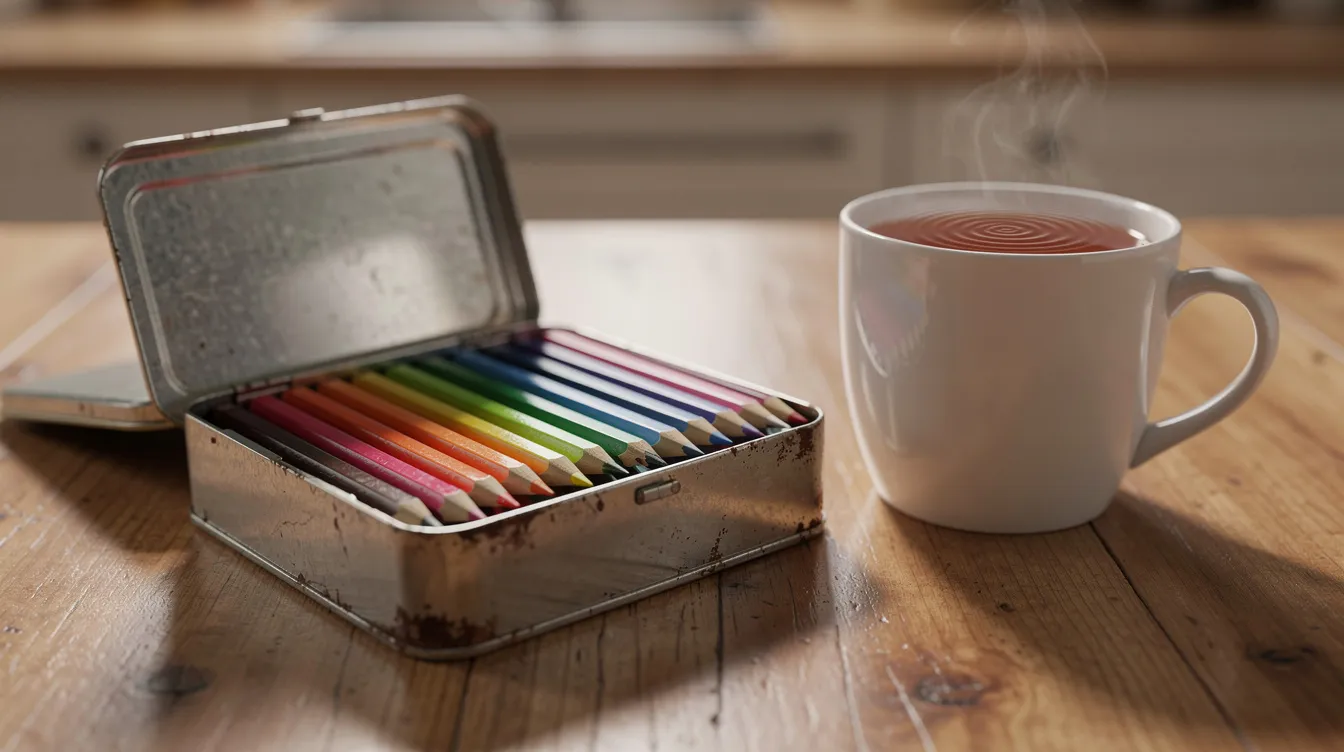
I work the early counter shift at a bakery in Sheffield, so by mid-afternoon I am home with the kettle on and a coloring book open on my small kitchen table. This is not a studio. It is a flat with one good window and a pot of tea, and I have been coloring for two winters now. The blog exists because I wanted to keep track of which pencils, papers and pages were worth the money on a bakery wage, and which ones were not.
If you want the short answer before all the detail: for most people, a mid-priced set of 24 to 36 soft or medium core pencils is the place to start, plus a few single pencils from a pricier range once you know what you like. A smaller set of decent pencils beats a huge set of scratchy ones every time, so do not start with the biggest tin you can find. If you have never coloured on a page before, my first steps with colored pencils post covers the basics.
How I’m Choosing These Recommended Colored Pencils
These picks come from two winters of buying, testing and sometimes regretting. I focus on colored pencil sets I actually own or have borrowed long enough to use properly in 2024 to 2026, not just what everyone else lists. I have paid for almost all of them myself, and every time I hand over money for art supplies I feel it.
I am writing for adult colourists and casual artists in the UK and elsewhere who want straightforward, practical advice and honest talk about price. I started the blog to keep track of what was worth the money, and that has not changed.
I will mostly ignore huge “school packs” and watercolor pencils in this guide, and focus on regular colored pencils you can use in adult coloring books and on loose paper. If you are after graphite pencils for sketching, that is a different conversation. Same if you want markers. This is about dry colored pencils, the kind you sharpen and press onto a page.
One thing that helped me early on was reading the Wikipedia article on colored pencils. It gives a clear overview of wax based and oil based cores and the different grades, and it explained why my pencils behaved so differently from each other. If you are confused about core types, that is a good starting point before spending anything.
What Matters Most in a Good Colored Pencil Set
I am a hobbyist, so I judge pencils by how they behave on a printed coloring page at a kitchen table, not under gallery lights. Here is what I look for.
-
Pigment strength. How bright or rich the colour looks in a single layer and after several layers. Weak pigment means going over the same patch again and again, which wears out cheap paper fast. Pigmentation impacts the richness and vibrancy of what ends up on the page, and higher pigment concentration generally results in richer colors. Colored pencils vary significantly by core composition and pigment load, and that difference shows up immediately.
-
Blendability and core hardness. Whether pencils layer smoothly and burnish without waxy clumps, and how soft vs firm cores affect comfort, detail work and sharpening. There are two primary types of colored pencil cores: wax based and oil based. The main differences lie in pigment load and lightfastness, but you feel it in practice too. Wax based pencils are softer and easier to blend than oil based pencils, while oil based pencils tend to hold a sharper point for detailed work. Softer cores are better for blending colors easily and color fast, but they wear down quickly. Harder cores hold a sharp point but can feel thin and pale on the first pass. Blendability allows colors to transition smoothly without harsh lines, and that matters if you want gradients or soft backgrounds.
-
Breakage. A pencil that snaps inside the wood every time it drops is a waste of money. I have had a few. Good colored pencils can minimize breaking during sharpening or drawing, and features like SV bonding, where the lead is glued through the full length of the wood, help a lot.
-
Paper friendliness. How the pencils behave on common adult colouring papers: Amazon-print books, Johanna Basford style books, smooth Bristol, and toothier drawing papers. Some pencils look gorgeous on quality paper but scratch or skip on cheap glossy stock.
-
Lightfastness. This measures a color’s resistance to fading over time. If pages just live in a folder or a closed book on a shelf, do not let it drive the decision. But lightfastness is crucial for artwork longevity if you plan to frame, sell or gift pieces that will hang in bright rooms. The Wikipedia page on lightfastness explains the idea properly if you want to understand the testing standards before deciding whether it matters to you.
-
Range of colors, set sizes and open stock. A set with six near-identical greens and no good grey is not much use, so I look at the spread before the price. Quality pencils allow building multiple colors without quickly saturating the paper, and layering ability allows multiple colors to build up gradually. Open stock matters because you can replace your most-used colours instead of rebuying whole tins.
-
Price and availability in 2024 to 2026. Rough UK prices in pounds, and whether they are easily found in supermarkets, on big online shops, or only from specialist art stores. Budget affects the quality of colored pencils you can buy, and I try to be honest about where the sweet spot sits for people like me.
Best 7 Colored Pencil Sets I Honestly Recommend in 2026
I am not ranking these from “worst to best” but from “most generally useful for my readers” to more niche or pricier options. All seven are sets I would happily use for a full page, with a mix of beginner-friendly and “treat” sets. My own sweet spot is the mid-range, and the pricier sets are nice to have, not essential. There are other pencil brands worth trying, including Chameleon Color Tones pencils, which have a blending color on the other end for easy blending with dual tips and blend well while holding a sharp point. And ranges like Koh-I-Noor Polycolor and Lyra Rembrandt Polycolor have loyal followings among professional artists. But I am sticking to the seven I know best.
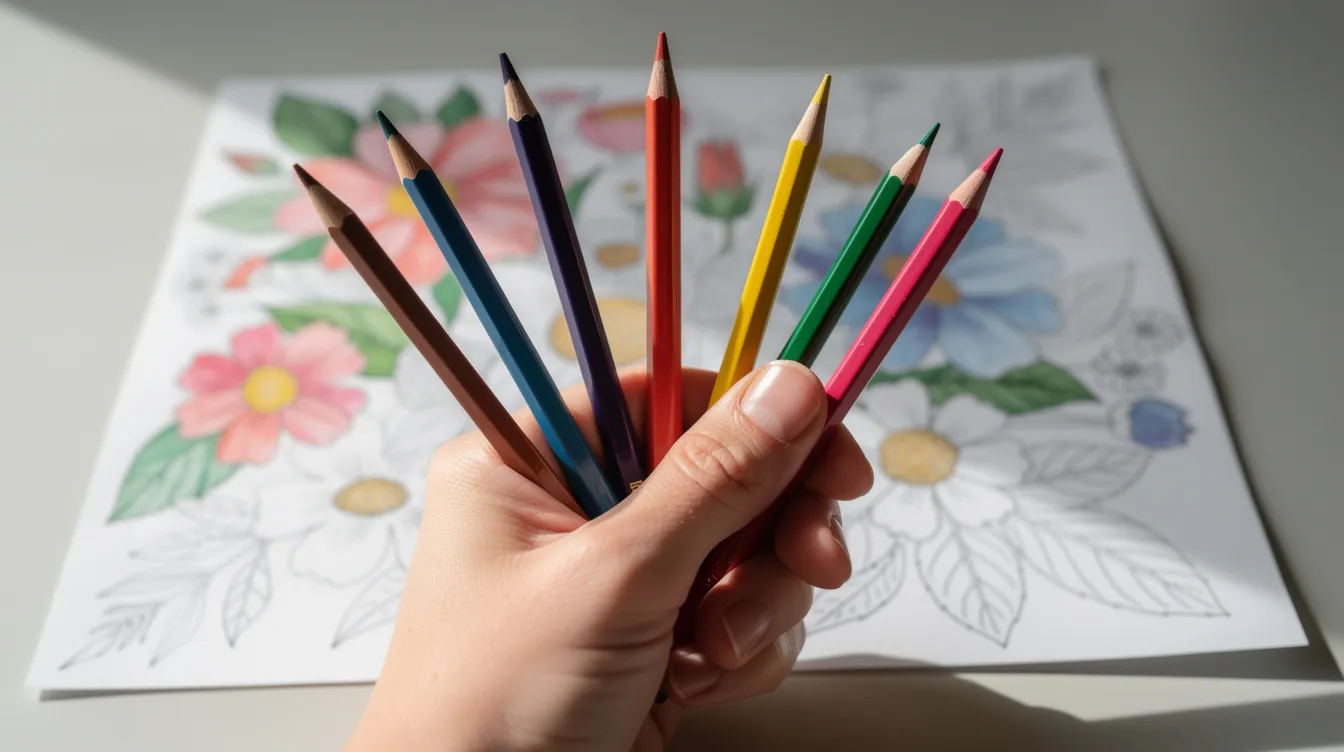
1. Prismacolor Premier Soft Core: Best All-Rounder for Adult Coloring Books
Prismacolor Premier colored pencils are very soft, creamy, famous for smooth blending, and widely used by hobbyists and pros. They are loved by many colorists for their rich cores, and Prismacolor Premier pencils are popular for their creamy texture. If you have seen colored pencil art on social media with those impossibly smooth backgrounds, there is a good chance Prismacolor pencils were involved.
Why It Stands Out
Prismacolor Premier pencils blend easily and lay down vibrant color, even on cheap Amazon paper and thicker books like Kerby Rosanes, without much streakiness. They handle backgrounds, skin tones and smooth gradients with minimal effort. The way the pencil lays down color in a single pass is noticeably richer than most student sets. Prismacolor Premier pencils are recommended for beginners and professionals alike, and they are one of the easiest step-up pencils for someone moving beyond Crayola-type sets, though I would never tell a beginner they need to start here.
Best For
-
Adult colouring book fans who want soft, blendy pencils, are starting to layer colours, and like rich color with fewer layers.
-
People who mostly work in books, not on framed professional artwork in direct sunlight.
Key Strengths
-
Very soft wax core that makes smooth blending and gradients easy even on budget paper. Wax based colored pencils like these are forgiving on thin paper where firmer cores can scratch.
-
Huge range of colors, with sets going up to 72, 132 and 150 colours, and strong pinks, blues and greens. The color range covers bright colors and cool tones equally well.
-
Available open stock in most decent art shops, so you can replace favourites like White, Cream and Dark Umber. In the UK, a 24-colour set runs about £30, which works out to roughly £1.25 per pencil. Affordable for artist quality compared to European premium brands, especially during sales.
Possible Limitations
-
Soft cores break more easily if dropped or sharpened with aggressive sharpeners. Mine sometimes break in the sharpener and I have had a few with off-centre cores, so quality control can vary. Your experience may differ.
-
Wax bloom on heavy layers, which is that faint cloudy film that appears after a day or two on heavily worked areas. Some colours are also less lightfast, so these are not ideal for serious gallery work. If you notice wax bloom, a gentle buff with a tissue or a light spray of workable fixative sorts it out.
Note that Prismacolor Scholar colored pencils are a more affordable student line from the same company. They are firmer and less creamy than the Premier range but still a step above basic sets.
2. Faber-Castell Polychromos: Best for Detail Lovers and Long Sessions
Faber-Castell Polychromos pencils are oil based and easy to blend in a controlled, layered way. They are firmer than the soft wax types, and popular with portrait and wildlife artists. Polychromos pencils hold a point beautifully, which makes them a great pencil for anyone who works small.
Why It Stands Out
The firm core holds a very sharp point for fur, hair, buildings and tiny mandala spaces. Oil based colored pencils like these allow clean, controlled layering with less wax build-up. Faber-Castell Polychromos are favored for their oil based quality, and oil based pencils are better for fine details than softer alternatives. Oil based pencils tend to hold a sharper point for detailed work, and that is exactly what makes them appealing for precise lines in intricate designs.
Faber-Castell Polychromos pencils have a 3-star lightfast rating for 102 of their colours, which means most of the 120-colour range is suitable for display pieces.
Best For
-
Intermediate to advanced colourists who enjoy slow, detailed work and are bothered by crumbly, soft pencils and constant sharpening.
-
Artists who mix colored pencil with markers or ink outlines and need precision. They suit mixed media work well because the oil binder does not react with most solvents the way wax can.
Key Strengths
-
Firm, oil based core with a 3.8 mm diameter that sharpens to a needle point and resists breakage.
-
Excellent lightfastness across most of the 120-colour range. Very smooth on toothier papers like Strathmore or Fabriano, and handles solvent blending well.
-
Available open stock almost everywhere that sells serious art materials. This is how I bought them: not a full set, just a handful of colours I use constantly. A 60-colour tin runs about £84.88 in the UK, which is roughly £1.42 per pencil.
Possible Limitations
-
Learning curve for people used to very soft pencils. They need more layers and patience to reach full saturation, and can feel a bit scratchy on very smooth, cheap paper compared with Prismacolor.
-
Higher upfront cost per pencil, especially in smaller UK shops.
3. Derwent Lightfast: Best for Lightfastness on a Big Budget
Derwent Lightfast colored pencils are Derwent’s flagship lightfast pencils, designed to last decades. Professional-grade pencils like these are designed for archival longevity and rich pigmentation, and Derwent Lightfast pencils are rated 100% lightfast for up to 100 years under museum conditions.
Why It Stands Out
-
100 percent lightfast across the full range, suited to professional artwork you want to hang or sell with confidence. Derwent Lightfast pencils are rated 100% lightfast for durability, meeting ASTM D-6901 and Blue Wool Scale ISO 105 standards.
-
Creamy, rich cores somewhere between Polychromos and Luminance in feel, from a long-standing British company that is easy to find in UK art shops and online.
Best For
-
Artists creating original pieces to sell or gift, especially portraits and animals, and colourists who already know they love coloured pencils and want a “lifetime” set.
-
People who prefer to support a UK-based brand.
Key Strengths
-
Every colour in the range is rated lightfast for museum-level conditions. These are lightfast pencils in the truest sense.
-
Thick, smooth core that covers tooth well and works nicely on toned paper and textured papers.
-
Open stock available, with good neutrals and greys, in sturdy tins and wooden boxes that actually protect the pencils. A 36-colour tin sells for about £99.95 in the UK, and individual pencils cost about £3.20 each.
Possible Limitations
-
Very expensive pencils per unit, and probably overkill for many colouring book fans. These are among the most expensive pencils in UK art shops.
-
Small starter sets (like 12) feel quite limited; you really need 36 or more to enjoy the system. Heavy burnishing on very smooth paper can show a little streaking.
4. Caran d’Ache Luminance: Best Luxury Pencils for Creamy Coverage
Caran d’Ache Luminance pencils are often described as the “Rolls-Royce” of coloured pencils. They are wax based with a buttery laydown and high lightfastness, and Caran d’Ache Luminance pencils are known for their buttery texture. If you have ever picked up a pencil and thought “this feels expensive,” this is the one.
Why It Stands Out
-
Exceptionally thick, opaque 3.8 mm cores that cover the paper quickly, even on toothy stock, with a palette packed with natural skin tones and muted colours. Caran d’Ache Luminance pencils are known for their superior lightfastness, with 81 of their 100 colours rated LFI under ASTM D-6901, which is the top grade.
-
They blend beautifully, like very soft wax based pencils, but feel sturdier in the hand than Prismacolor for many people. The superior blending and vivid color you get from these cores is hard to match.
Best For
-
Portrait artists and colourists who love skin tones, botanicals and gentle palettes, and who are happy to invest serious money into a long-term set. Professional quality work benefits enormously from the pigment quality in this range.
Key Strengths
-
Soft, creamy cores that give strong colour in few layers and handle layering and burnishing beautifully, with all colours rated highly lightfast. The creamy texture gives each pencil a satisfying weight on the page.
-
Excellent coverage on smooth Bristol as well as heavier art papers.
-
Useful doubles with other pencils: many artists combine Luminance white pencils and skin tone pencils with cheaper pencil brands, which fits my “small set plus singles” approach.
Possible Limitations
-
One of the most expensive coloured pencil ranges on the market, and sets jump in price significantly between 20, 40 and 76.
-
Casual hobbyists may not notice the extra subtlety compared with cheaper artist grade colored pencils. I would say it is a treat, not a need.
5. Derwent Chromaflow: Best Mid-Priced Upgrade from Budget Pencils
Derwent Chromaflow is Derwent’s softer, wallet-friendlier range aimed at hobby colourists, and it sits in the same mid-range territory I think most people should land in. If you want the feel of artist grade pencils without the price tag that makes you wince, this is a strong option.
Why It Stands Out
-
Soft, blendable core that feels closer to Prismacolor than to classic student sets, with bright, modern colours that suit colouring book paper. The pencils blend smoothly without much effort, and the way the pencil lays colour is noticeably richer than cheaper alternatives.
-
Often on offer in UK stationery chains and online, making them an accessible step up at an affordable price.
Best For
-
Beginners who have outgrown Crayola-style pencils and want something softer but not too pricey. Amateur-grade pencils are more budget-friendly and accessible for beginners, and Chromaflow sits nicely above that bracket.
-
People who mainly colour in books and do not need perfect lightfastness or open stock, and enjoy bold, saturated pages rather than ultra-detailed realism.
Key Strengths
-
Soft, vibrant cores that blend nicely even on mid-range paper, producing vibrant colors with less effort than firm cores.
-
Good colour selection in sets like 24, 36 and 72, covering brights and useful neutrals, at a reasonable price for the performance.
-
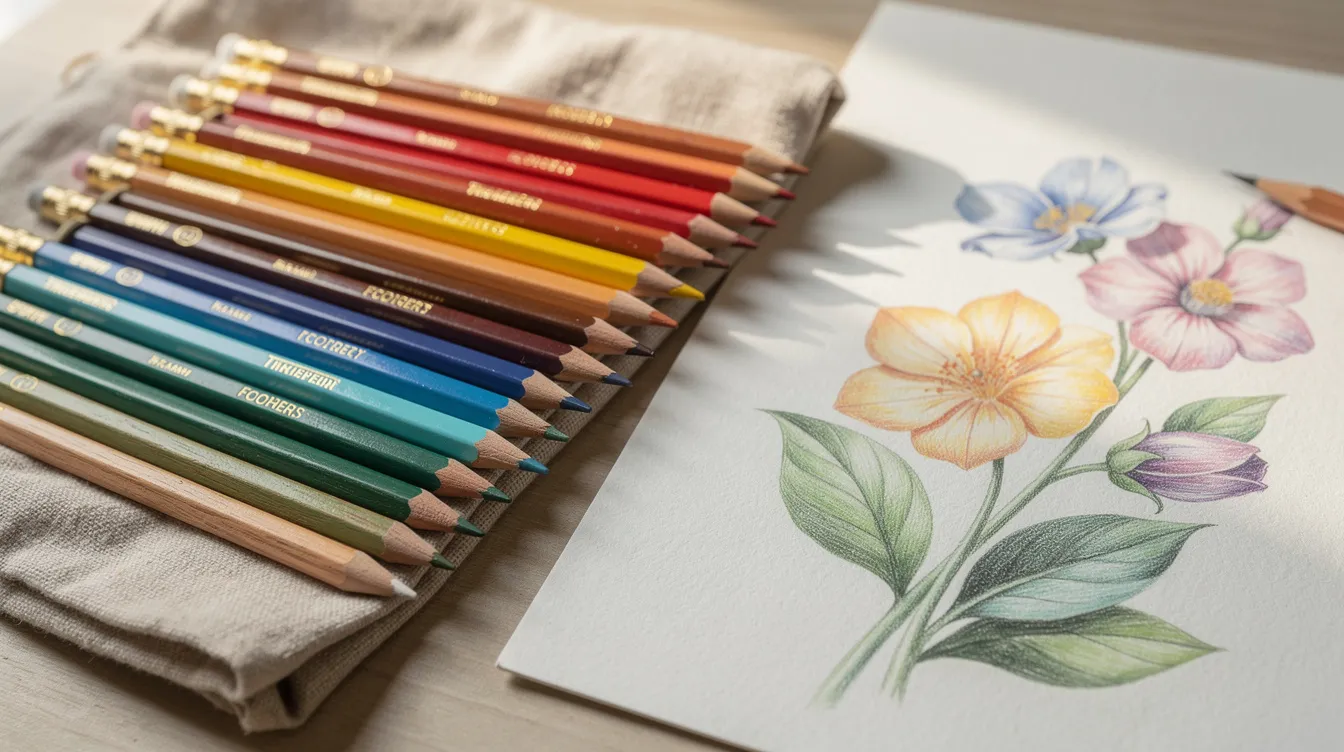
Barrels clearly printed with colour names and numbers for swatching and tracking favourites. This is genuinely useful when you start collecting favourites.
Possible Limitations
-
Not fully lightfast rated, so not the right choice for work you plan to hang long term in strong light.
-
Open stock availability can be patchy, and the soft core can still be fragile if dropped or sharpened too aggressively. Keep a good sharpener nearby. Derwent’s softer Coloursoft pencils behave the same way, and Derwent Studio pencils keep a sharp point well and resist breakage if you prefer a firmer feel from Derwent’s range.
6. Faber-Castell Goldfaber / Goldfaber Aqua (Dry Use): Best Versatile Mid-Range Set
I am focusing on using these dry in colouring books, even though Goldfaber Aqua are technically watercolor pencils. Worth mentioning that Faber-Castell Classic Colour is the range I see most often in UK shops and a sensible starting point: reliable, pleasant colours, clean sharpening. Faber-Castell Classic Color Pencils are great for kids and beginners. But Goldfaber is a step up from there.
Why It Stands Out
-
Goldfaber: wax based, smooth without being mushy, easy to control for both colouring books and sketching. The 3.3 mm cores are SV bonded, meaning the lead is glued full-length to reduce breakage. Goldfaber Aqua: slightly softer, can be activated with water, but still performs nicely dry.
-
Both ranges perform better on black paper, dark paper and toned paper than very cheap sets. Even Faber-Castell Black Edition pencils, designed for dark paper, share some of that Faber-Castell engineering quality.
Best For
-
People who want one set they can use for both casual colouring and more serious drawing practice, and anyone gifting pencils to an adult beginner who might branch into sketching later.
-
Beginners who value strong, simple wooden barrels and reliable sharpening.
Key Strengths
-
Firm-but-smooth cores that keep a point for fine details but still layer and blend, with very solid build quality and break-resistant leads. This is a high quality pencil range without the high-end price.
-
Good colour balance in sets of 24 to 48, with enough earth tones to feel grown-up.
-
More affordable than Polychromos while still feeling like “proper” artist quality pencils. The pigment quality is respectable for the price.
Possible Limitations
-
Less creamy than Prismacolor or Chromaflow, so they demand a bit more layering. Softer pencils will fill large areas faster.
-
Lightfast information is not as clearly pushed as in the pro lines, and open stock can be harder to track down depending on country.
7. Crayola Colored Pencils (Full-Size): Best Ultra-Budget Option That Still Works
Crayola colored pencils are not artist grade, but many of us started here and they can still make lovely colouring pages. My caution is this: the very cheapest supermarket and stationery-shop sets often look chalky and thin on the page, which is discouraging after an hour on a detailed design. If a set feels scratchy when you test it, put it back. Crayola, at least, delivers what it promises.
Why It Stands Out
-
Widely available almost everywhere, from supermarkets to bargain shops, at very low cost. Crayola Colored Pencils are affordable and beginner-friendly, often under £10 for a set of 24.
-
Firm enough to survive being thrown in a bag and sharpened with cheap sharpeners, with a huge colour range in big sets and fun bright colors for mandalas and simple pages.
Best For
-
Absolute beginners testing whether adult colouring is for them without spending much, and parents or carers sharing supplies with children’s colouring pages.
-
People who like flat, graphic styles more than super-blended, painterly looks.
Key Strengths
-
Very affordable, often under the price of a takeaway for large sets, and available in many themed sets so you can top up colour ranges easily.
-
Hard pencils that hold a point well for line work and tiny spaces, and they perform noticeably better on quality paper, which can surprise new colourists. Even cheaper pencils can look decent when the paper cooperates.
Possible Limitations
-
Less pigmented than artist grade pencils, so it takes more layers to reach rich color. The pencils carry less more pigment per stroke compared to premium brands.
-
Blending is limited, with a tendency to look scratchy on very smooth, cheap paper. No lightfast information, so not suitable for display work in bright rooms.
Quick Comparison of My Recommended Colored Pencils
Here is a fast way to match a set to your situation. Choosing pencils is partly about personal preference, partly about budget, and partly about what you actually do with them.
|
Set |
Core Type |
Best For |
UK Price Range |
Lightfast? |
|---|---|---|---|---|
|
Prismacolor Premier |
Soft wax |
Blended colouring book pages |
~£30 for 24 |
Mixed |
|
Faber-Castell Polychromos |
Oil based |
Detail, portraits, precision |
~£85 for 60 |
Yes, most colours |
|
Derwent Lightfast |
Oil/hybrid |
Framing, selling, archival |
~£100 for 36 |
Yes, 100% |
|
Caran d’Ache Luminance |
Wax based |
Luxury coverage, portraits |
~£60-70 for 20 |
Yes, most colours |
|
Derwent Chromaflow |
Soft wax |
Upgrading from budget sets |
Mid-range |
Partial |
|
Faber-Castell Goldfaber |
Wax based |
Versatile sketching and colouring |
Mid-range |
Not rated per pencil |
|
Crayola |
Firm wax |
Beginners, tight budgets |
~£4-10 |
No data |
How to Choose the Right Colored Pencils for You
There is no single “best” colored pencil. There is only the best fit for how and where you colour. Before spending money, it helps to answer a few practical questions about budget, paper, goals and storage. Consider your artistic purpose when choosing colored pencils, and be honest about how much time and money you want to put in.
My test-before-you-commit routine: swatch in a shop if you can, using both light and firm pressure. Try layering two colours on top of each other. Sharpen one to see if the tip crumbles. And buy a small set of 12 or 24 before spending on 72. You learn more from finishing one book with a small set than from staring at a huge tin wondering where to start.
Choose Based on Your Budget (and Future Refills)
Compare the rough price tiers: Crayola at the bottom, Chromaflow and Goldfaber in the middle, Polychromos and Prismacolor higher, Luminance and Lightfast at the top. The best quality pencils cost more per unit, but that does not mean you need the most expensive set to enjoy coloring.
I learned this the hard way. I bought a big set first because it looked like better value, used about a third of the colours, and the rest sat in the tin. These days I buy a modest set and fill gaps with singles. A good neutral grey, a deep green and a warm brown did more for my pages than another ten pastel shades. If you can only afford one mid-range set, pick the widest colour range you can afford over the most prestigious name on the tin. Budget affects the quality of colored pencils you can buy, but spending wisely matters more than spending a lot.
Open-stock availability makes expensive pencils more economical in the long run if you colour a lot. Polychromos and Lightfast are easy to buy as singles in the UK. Prismacolor Premier open stock can be trickier to find depending on where you shop.
Choose Based on How You Actually Colour
There is a real difference between heavy, blended pages with soft backgrounds and flat, neat colouring with clear lines. For backgrounds, skies and soft shading, softer pencils like Prismacolor, Chromaflow and Luminance are quicker and more satisfying. Their soft cores fill paper fast. For intricate designs, tiny spaces and fine line work, firmer pencils like Polychromos, Goldfaber and even Crayola give you more control.
My own routine: a mid-range soft set for most of the page and a few firmer Faber-Castell pencils for small details and precise lines. I keep a small pencil case of just the colours in a current project, so there is less choice and less rummaging. This also means I actually finish pages instead of dithering over which shade of blue to use.
Marco Raffine pencils, which I have tried briefly, perform better on quality paper than on cheap book pages, and they are another decent mid-range option worth testing if you come across them.
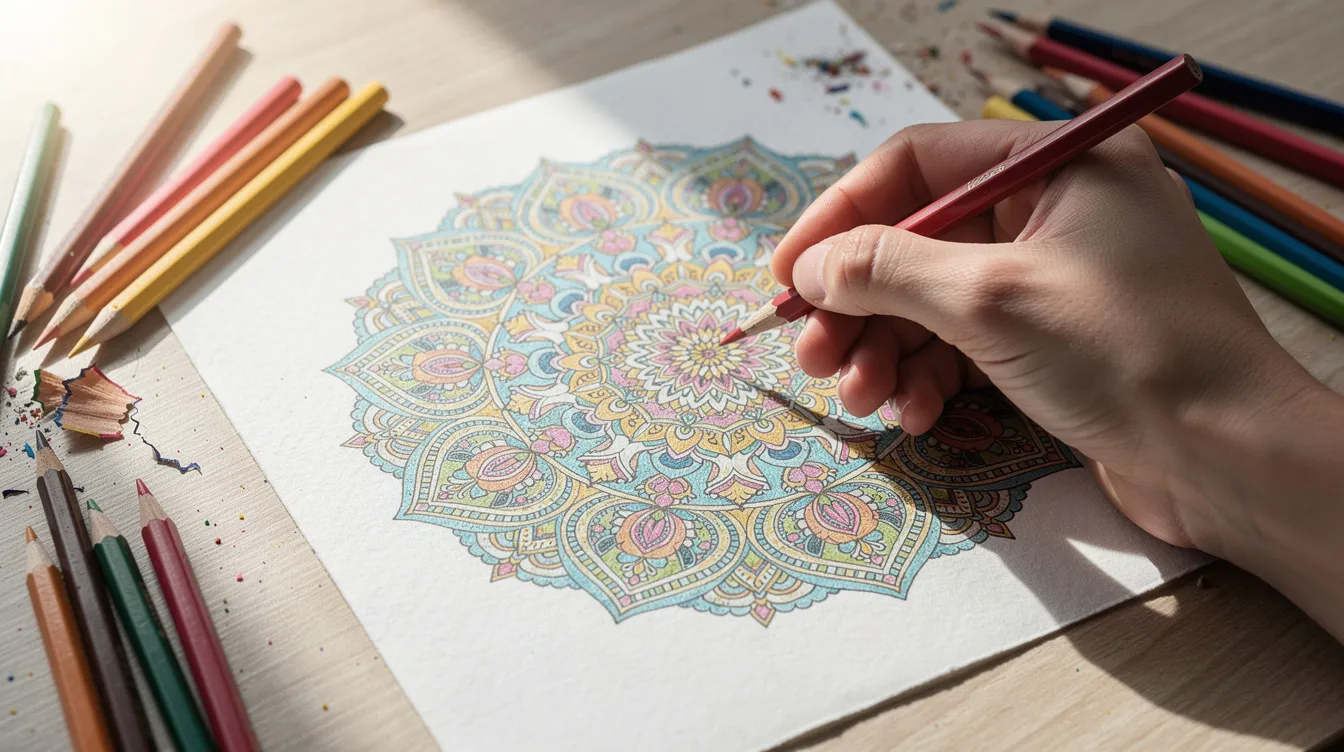
Choose Based on Paper and Lightfast Needs
Cheap, thin paper in some colouring books behaves very differently from thick, toothy card or Bristol. The best colored pencils will still struggle on thin, glossy paper, which tears or pills if you layer too much. Colored pencil paper matters almost as much as the pencils themselves.
For home-printed pages, slightly heavier paper around 120 to 160 gsm makes layering and blending much easier. The tip I wish I had known sooner: put a spare sheet under your page for a little cushion and to protect the table. It also makes softer pencils feel smoother.
I have a guide on how to start colouring with pencils elsewhere on the blog, for readers who want the basics of technique before buying anything.
Lightfastness really matters when you are making artwork for walls, commissions, or gifts left out in bright rooms. For purely private colouring books stored on a shelf or in a folder, Prismacolor, Chromaflow or Goldfaber are usually fine. For a page on the wall, look for a published lightfast rating and keep it out of direct sunlight. Colored pencil drawing that stays in a drawer will hold its colour for years regardless of rating, but anything near a window needs protection.
Which Colored Pencils Are Best for You?
Most colored pencil brands have something to offer, and the best colored pencils for you depend on how you colour, what you colour on, and what you plan to do with the finished page. Here is the quick version.
-
Choose Crayola Colored Pencils if you are just starting out, share with kids, or want to test the hobby with almost no financial risk.
-
Choose Derwent Chromaflow if you love bright, soft colour in colouring books and want an affordable upgrade from school pencils.
-
Choose Faber-Castell Goldfaber if you want sturdy, mid-priced pencils that work for both doodling and more serious sketches.
-
Choose Prismacolor Premier Soft Core if your priority is ultra-smooth blending and rich pages on typical adult colouring paper.
-
Choose Faber-Castell Polychromos if you focus on detail, realistic pieces, or plan to mix pencils with markers and fine liners.
-
Choose Derwent Lightfast if you are in the UK and want fully lightfast pencils for pieces you might frame or sell.
-
Choose Caran d’Ache Luminance if you already love colouring, want a treat set, and care about lightfastness and creamy coverage.
Final Thoughts
You do not need the most expensive set to enjoy colouring. Practice, paper choice and enjoying the process matter more than the brand stamped on the barrel. A good afternoon with quality colored pencils, a decent page and no pressure to make it perfect is worth more than a shelf full of professional pencils you are afraid to use. I have seen people do beautiful colored pencil art with a tin of mid-range pencils and some patience, and I have seen expensive sets sit untouched because the owner felt they were not “good enough” to use them.
The set I reach for most at my little table in Sheffield, with a pot of tea going cold beside me, is still a mid-range soft wax set with a handful of Faber-Castell Polychromos singles for the fiddly bits. That might change over time. It probably will. My What I Color With page is a running list of everything I use with notes on what I would buy again, so you can see my current favourites rather than what I was using last winter.
Start with what you can afford. Learn what you like. Upgrade only when the pencils are holding you back, not when an advert tells you to.
FAQ
What is the best colored pencil brand for beginners?
There is no single best brand, but Faber-Castell Classic Colour, Staedtler Ergosoft and Derwent Coloursoft are solid and widely available. Start with a smaller set from one of these rather than a huge budget tin. Prismacolor Premier pencils are also recommended for beginners who want to jump straight to richer colour, though they cost a bit more.
How many colored pencils do I need for coloring pages?
A set of 24 to 36 is plenty for most pages. That gives you enough contrast, a few good neutrals and room to mix. Add single pencils later for colours you find yourself missing. You do not need 150 colours to colour a flower.
Are expensive colored pencils worth it?
Sometimes. Artist grade pencils can give richer color and smoother blending, and the best quality pencils feel noticeably different from budget ones. But they are not necessary to enjoy coloring. Try a mid-range set first and upgrade only if the pencils are holding you back. A great pencil is the one you actually use, not the one that costs the most.
Do soft or hard cores work better for coloring pages?
Soft cores are quicker for filling areas and blending, while harder cores are better for small, crisp details. I use mostly soft pencils with a few harder ones for fine work. It is largely personal preference, and many colourists end up mixing both types on the same page.
Can I use any paper with colored pencils?
You can, but smoother, slightly heavier colored pencil paper gives better results. Thin or glossy paper can tear, pill or refuse layers, so check your coloring book or printer paper before investing in fancy pencils. Even other pencils in your collection will perform differently on different paper, so a quick test on a spare page is always worth it.